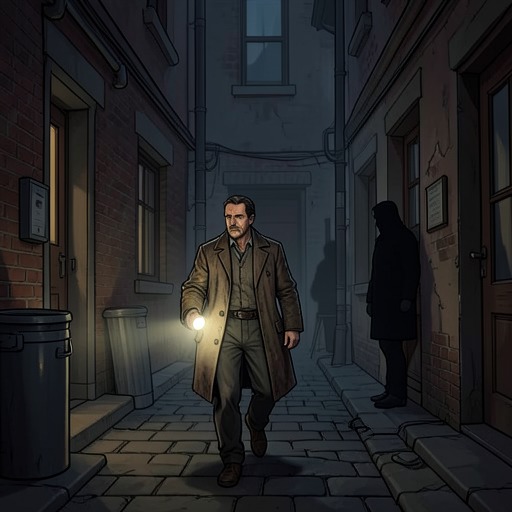
Bill Hodges's home
Mr. MercedesBill Hodges’s home at 63 Harper Road is the domestic center of his retired life and the working base from which he resumes investigating the Mercedes Killer. Its silence, legal pad, and familiar neighborhood routines mark a return to purpose; its unshaded windows and the killer’s attention to Hodges’s whereabouts expose how little separation the house offers between private life and danger.
Setting and Everyday Use
The house is identified as 63 Harper Road, in Hodges’s West Side neighborhood. At home, Hodges works in a manner that suits him: one night he leaves both television and computer off, takes out his legal pad, and reviews the letters sent to him and Olivia Trelawney. He reads them repeatedly, marks a copy of Olivia’s letter, and reads both aloud in different voices to compare their contrasting personae. The quiet house becomes an improvised analysis room, where old-fashioned habits support the new investigation.
The home is also the starting point for work that carries Hodges beyond its walls. He canvasses Harper Road by knocking on neighbors’ doors and presenting his retired identification, explaining that he is checking for suspicious vehicles on his own initiative. The residents include retirees balancing food costs against medicine near the end of the month. His account gives the canvass a practical neighborhood purpose, while the house’s place among those homes gives him a personal stake in their security.
A Base for Renewed Purpose
The letters found in the investigation sharpen Hodges’s interest in the case. After considering that correspondence from the Mercedes Killer might be among Olivia’s personal papers, he privately resolves to pass any progress to his former partner, Pete Huntley. Later, at home, he studies both letters in close detail. The house is thus not merely a refuge from retirement: it is where a private, unauthorized inquiry takes shape through patient reading and note-taking.
A prospective private-investigation job gives that renewed activity a more concrete form. Hodges imagines the familiar hard-boiled detective image—a small office, a receptionist, a trench coat, and a brown fedora—but recognizes that the fantasy is not the real attraction. What draws him is the prospect of leaving the La-Z-Boy and re-entering active work. His home stands in contrast to that imagined professional life, embodying the sedentary routine he is beginning to leave behind.
Exposure and Threat
The house’s windows become a security concern when Hodges considers whether the killer could have watched him from outside. He realizes that he has never thought to pull the shades and wonders whether someone could have seen him handling his father’s .38 revolver. Jerome Robinson is another possible witness, though Hodges reasons that Jerome would have been alarmed and said something if he had seen. The episode turns the familiar living room into a place that may be visible to an unseen observer.
The danger is also registered through Hodges’s absence. On a Friday afternoon, Brady Hartsfield cruises slowly past number 63 and looks toward the window, but the drapes are drawn and the overhang contains only a lawnmower. Hodges is away in his old Toyota rather than sitting at home watching television; that unexpected absence makes Brady vaguely uneasy. The house’s ordinary details—the closed curtains and lawnmower—therefore interrupt the killer’s expected view and reveal the surveillance built around Hodges’s routine.
A Threshold Between Safety and Risk
Hodges leaves home one day without any premonition that he will not return. This departure gives the residence a quiet but consequential place in the story: it is the point from which he conducts his renewed investigation, the setting for his solitary examination of evidence, and a location whose apparent privacy cannot guarantee safety. The contrast between the calm routines inside and the attention directed toward the house makes 63 Harper Road both a haven of habit and a vulnerable threshold.